
Date:
Location:
Speaker:
Abstract: Chiral assemblies are ubiquitous and intimately related to the evolution of life on Earth. Chiral assemblies of -conjugated molecules are particularly fascinating, which Nature uses to efficiently transfer electrons and transduce energies leveraging their electronic conductivity, redox activity as well as the chirality-induced spin selectivity effect. To date, the intriguing properties of chiral assemblies remain largely unexplored and unknown in synthetic electronic systems such as -conjugated polymers. This is largely due to the synthetic bottleneck to develop chiral semiconducting molecules that exhibit both high performance in terms of charge, exciton or spin transport and exceptional chiral optical properties – the ability to twist light. Further, it is widely believed that the spin-orbit coupling is weak in organic materials which limits their potential applications in spin-based electronic devices. Because of these reasons, the transformative impact of chirality on electronic materials remains largely untapped. Our approach is to circumvent the complex synthetic challenge for inducing chirality. Instead, chiral symmetry breaking occurs through hierarchical helical supramolecular assemblies of high-performance achiral polymer semiconductors. This hypothesis is based on our recent serendipitous discovery that chiral assemblies can emerge during solution printing of polymer semiconductors that are inherently achiral. The helicity manifests itself across length scales spanning 10 nanometers to 10 microns, akin to the fascinating hierarchical helicity of biomolecules in our body. We now have observed this previously overlooked phenomenon across a wide range of common semiconducting polymers, and show that supramolecular chirality spontaneously emerges when the molecule length exceeds ~10 nanometers. The “wonderland” ultimately lies in the intriguing properties when “chirality” and “electronics” merge. In these materials comprised of only light elements, we observed exceptionally high spin-orbit coupling on par with heavy metal owing to the ability of chiral structures to lock in spin momentum. Control over spin momentum in chiral helical structures redefines the rules of chemical doping, significantly boosting electrical conductivity. Beyond boosting conductivity, supramolecular chirality can enhance solar cell device stability by orders of magnitude. We believe this is just the beginning of unlocking the power of chirality in designing next generation electronics, optoelectronics and spintronics, learning from Nature’s electronics.
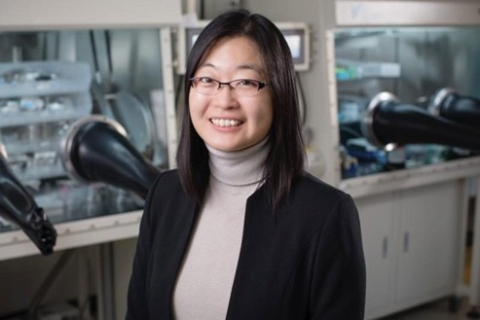
Bio: Ying Diao is a Professor, University Scholar, LAS Dean's Distinguished Professorial Scholar and Dow Chemical Company Faculty Scholar in Department of Chemical and Biomolecular Engineering at University of Illinois at Urbana-Champaign. She serves as the Co-Chair of Molecular Science and Engineering in the Beckman Institute of Advanced Science and Technology, and a Thrust Lead of the Molecular Maker Lab Institute - an NSF AI Institute. She received her Ph.D. degree in Chemical Engineering from MIT in 2012. Her doctoral thesis was on understanding heterogeneous nucleation of pharmaceuticals by designing polymeric substrates. In her subsequent postdoctoral training at Stanford University, she pursued research in the thriving field of printed electronics. Diao group, started in 2015 at Illinois, focuses on understanding assembly of organic functional materials and innovating printing approaches that enable structural control down to the molecular and nanoscale. She has over 130 publications which have been cited ~ 13,000 times. Her work has been frequently featured in scientific journals and news media. She was named to the MIT Technology Review’s annual list of Innovators Under 35 as a pioneer in nanotechnology and materials. She is also a recipient of NSF CAREER Award, Sloan Research Fellow in Chemistry, NASA Early Career Faculty Award, 3M Non-Tenured Faculty Award, AIChE Allan P. Colburn Award and AIChE Owens Corning Early Career Award. In 2025, she received the Presidential Early Career Awards for Scientists and Engineers from President Biden.